Key Takeaways
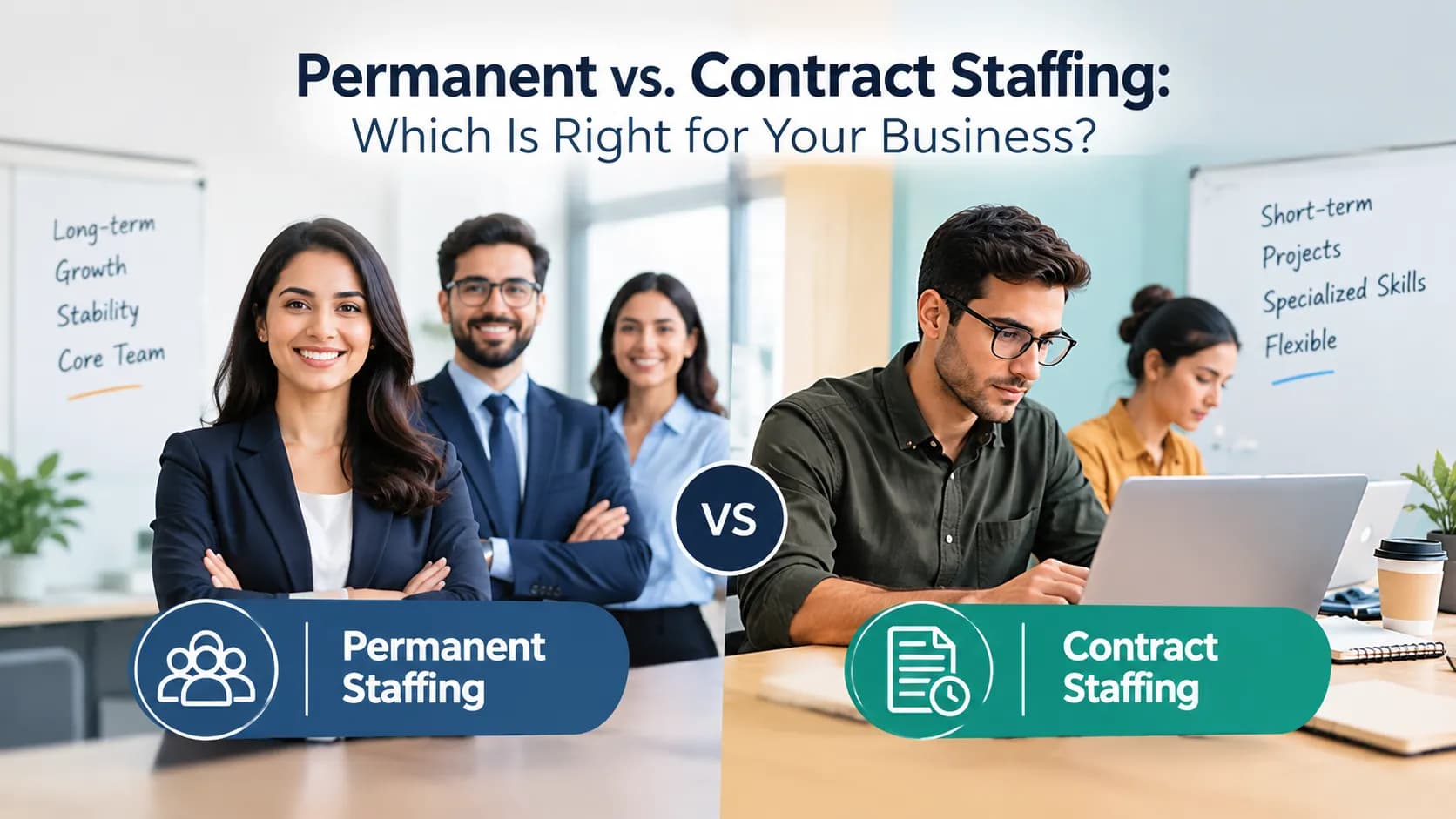
- Whereas finding the right people is crucial for any organization, it is important to keep in mind the necessity to choose between employees, which are going to be employed for an extended period of time, and specialists, which are going to be engaged only in a certain project, a temporary increase in activities or in possession of a narrow set of skills.
- The differences between both types of staffing can be examined on the basis of time and the payment for the services provided.
- FactorPermanent staffingContract staffingDurationOngoing employmentDefined term or assignmentBest suited forCore, continuing responsibilitiesProjects and temporary needsWorkforce flexibilityLower flexibility to reduce staffing quicklyEasier to plan around defined end dates, subject to contract termsRecruitment planningFocuses on long-term role fitFocuses on immediate skills and assignment requirementsKnowledge retentionSupports continuity and institutional knowledgeKnowledge transfer may be needed when the assignment endsCost considerationsSalary, benefits, onboarding, and long-term employment costsContract rates, agency fees where applicable, onboarding, and assignment costsDevelopmentSupports long-term training and career progressionTraining is often focused on assignment requirementsMain considerationSustained workforce commitmentClear scope, duration, and transition planningThe Real Cost and Liability Involve Many Things like Location, Status of the Workforce, Contracts, and Employment Agencies.
- Permanent staffing is usually more appropriate when the role contributes to the firm’s core activities and is likely to remain relevant in the future.
Table of Contents
- 1. Which Is Right for You?
- 2. What are the Differences Between Contract Staffing and Permanent Staffing?
- 3. Key Differences Between Contract Staffing and Permanent Staffing
- 4. When Should Businesses Choose Hiring?
- 5. Contract Staffing: What Are Its Advantages?
- 6. Which Staffing Model Fits Different Business Situations?
- 7. How Do You Determine the Appropriate Staffing Model?
- 8. Is it possible to combine them? Contract Staffing in the Business?
- 9. How Does Elite Maverick Support Staffing Decisions?
- 10. Conclusion
Quick Answer
Permanent staffing will be suitable for those companies which wish to keep their employees for a long time and also wish to develop their skills. On the other hand, contract staffing will be more suitable when you want to do something for a short time period or increase work load.
What are the Differences Between Contract Staffing and Permanent Staffing?
The differences between both types of staffing can be examined on the basis of time and the payment for the services provided. The permanent staffing means the acquisition of employees who would render their services on a consistent basis. The employees will be working for the firm under the terms and conditions provided for by the firm itself and the labor laws in this regard. Contract staffing refers to the fact that the people providing their services to perform the specialized and temporary tasks will be hired for one day, week or month.
Key Differences Between Contract Staffing and Permanent Staffing
| Factor | Permanent staffing | Contract staffing |
|---|---|---|
| Duration | Ongoing employment | Defined term or assignment |
| Best suited for | Core, continuing responsibilities | Projects and temporary needs |
| Workforce flexibility | Lower flexibility to reduce staffing quickly | Easier to plan around defined end dates, subject to contract terms |
| Recruitment planning | Focuses on long-term role fit | Focuses on immediate skills and assignment requirements |
| Knowledge retention | Supports continuity and institutional knowledge | Knowledge transfer may be needed when the assignment ends |
| Cost considerations | Salary, benefits, onboarding, and long-term employment costs | Contract rates, agency fees where applicable, onboarding, and assignment costs |
| Development | Supports long-term training and career progression | Training is often focused on assignment requirements |
| Main consideration | Sustained workforce commitment | Clear scope, duration, and transition planning |
The Real Cost and Liability Involve Many Things like Location, Status of the Workforce, Contracts, and Employment Agencies.
When Should Businesses Choose Hiring?
Permanent staffing is usually more appropriate when the role contributes to the firm’s core activities and is likely to remain relevant in the future. It is better to invest in long‑term hiring when:
- The role is integral to regular operations. Finance, people operations, and other functions supporting the core business require consistent expertise.
- Experience of the firm's operations is required for the job. Long‑term positions give opportunities for an employee to gain necessary knowledge and skills.
- This position requires development and management. This type of position will be greatly improved through learning, gaining experience and managing.
- It requires stable cooperation among people. A permanent team can work better without changeovers.
For example, as the firm grows and its people operations department develops, it would be better for the firm to hire a human resources manager permanently to manage regular activities and take care of problems of employees.
Since the department will grow, the manager will be needed to support staff. However, it would be wise for the firm to consider the cost of such a decision.
Contract Staffing: What Are Its Advantages?
When it comes to contract staffing, firms have the opportunity to concentrate on making sure that their personnel suit their needs rather than thinking about their jobs as permanent ones.
Here are some of the benefits of staffing:
- Flexibility in staffing: Staffing by contract ensures that the right qualifications and staffing needs are met for a certain project or season.
- Access to expertise: The firm can address the requirements of a role demanding very specific skills.
- Time‑limited hiring: The contract can be aligned with the expected project timeline, which makes it possible to reduce the costs associated with long‑term positions.
- Ease of planning: Since contract-based recruitment happens on certain schedules, it becomes easier to plan the increase or reduction of the workforce based on the requirements.
For example, if a company creates a software product, then it can make use of contract staffing in order to complete the launch of the software product. These people will be needed for a short period, and thus it will become easier to cut costs while maintaining efficiency and completing the work on schedule.
Which Staffing Model Fits Different Business Situations?
The comparison of staffing options can be summarized in a few general recommendations based on the firms’ needs. For instance, the following staffing options can be considered in similar situations:
| Business situation | Model to consider | Why |
|---|---|---|
| Building a core finance team | Permanent | Recurring responsibilities and continuity |
| Delivering a time-bound technology project | Contract | Skills are needed for a defined assignment |
| Managing a temporary increase in orders | Contract or temporary staffing | Workforce capacity can match demand |
| Hiring a long-term department head | Permanent | Leadership continuity and strategic ownership |
| Filling a specialist skills gap | Contract or permanent | Depends on whether the skill requirement is temporary or ongoing |
| Expanding a growing business function | Often permanent, potentially mixed | The need may continue, but short-term capacity may also be necessary |
These suggestions merely provide the first grounds since there may be a case where a temporary assignment could necessitate a permanent staffing situation, but a long-term staffing situation would not be necessary in a short-term assignment.
How Do You Determine the Appropriate Staffing Model?
It is important that managers begin their analysis by analyzing the staffing requirements of the organization.
In particular, the following questions should be considered:
- How long is the need required? Determine whether the role is ongoing or was created for a specific project with an end‑date in mind.
- What skills are required? Consider whether the assignment requires specific knowledge of organization or industry or whether it is specialized.
- What are the costs associated with employing additional staff? What are the costs related to offering the benefits, recruiting, orientation, documentation, training, agency costs, and costs of separation?
- What are the effects of having the employee away on your organization? Assess the effects of the absence of the employee from the client’s perspective, duration of the absence, process, and remaining team members.
- What are the rules that you have to comply with? Find out the rules concerning staffing in general, classification of workers, benefits, payroll, and separation.
- What is the procedure for ending the work? In case of work with deliverables in a contract-based position, make sure that both sides understand the time frame and procedures.
Before making a final decision on the staffing, managers need to discuss issues with HR and finance to think through the implications of the decision.
For personalized guidance on choosing the right staffing model for your business, contact Elite Maverick to discuss your recruitment and workforce requirements.
Is it possible to combine them? Contract Staffing in the Business?
It is quite possible to combine contract staffing for surges and special projects and permanent staffing to ensure the central core of the workforce in organizations. The combination of staffing options is particularly beneficial when the firm operates with consistent duties but also has emerging project requirements.
When there is a proper delineation of duties, the use of different staffing options will prove most helpful since it would be necessary to define the duties of the workers, the contractors, and the managers. This way, it is advisable not to use the contract staffing option for replacing permanent positions especially where there is a need for continual contribution.
How Does Elite Maverick Support Staffing Decisions?
Elite Maverick offers both recruitment and contract/temporary staffing services as a part of its comprehensive recruitment solutions. In addition, the firm provides search and volume hiring options that allow potential clients to begin the discussion with a recruitment agency by defining the staffing needs based on the role category and volume.
Elite Maverick Talent, rather than focusing on the preference for one option over another, will help find the most appropriate staffing solution based on the role requirements, anticipated duration, and other factors. After the information is gathered, then the potential client can move on to evaluate the hiring and staffing options that could help in resolving their issues.
If a client wants to arrange for a discovery session with a recruiting partner, then he/she should provide the below information: Role and skills required; Start date and contract period; Terms & Conditions; Reporting to; Performance parameters; Compliance/Project timelines.
Conclusion
The staffing decisions that consider contract or permanent options should be based on the needs of the business and not dictated by a preference for one option over another. Permanent staffing can be a better choice when the firm wants to develop long‑term capabilities, retain the workforce, and maintain institutional knowledge while benefiting from the flexibility of contract staffing. A hybrid approach may well prove to be the optimal one in quite a number of cases. The position determination, cost calculations, priority analysis in retaining the labor force, and legal aspects will assist the company in making a wise decision.
For more recruitment insights, staffing updates, and hiring tips, follow Elite Maverick on LinkedIn.
Frequently Asked Questions
What is the main difference between staffing and contract staffing?
Permanent staffing involves hiring people for permanent positions while contract staffing is used in case of need for temporary, project-based, or specialized work.
Is contract staffing superior to permanent hiring?
No, as it is more costly than permanent hiring and the company needs to analyze all the pros and cons of each option.
What are the advantages of hiring?
Permanent staffing retains the staff, builds institutional knowledge, and helps to advance employee careers.
When should a company hire workers?
Contract workers may prove to be advantageous for seasons, certain tasks, replacing unavailable workers, and sudden spikes in demand.
Can contract employees become employees?
It is possible depending on the firm’s policies and legal regulations, as well as the terms of the contract and the availability of permanent roles.
What would determine the decision to adopt one or another staffing strategy?
Management is supposed to consider many factors including time required for this job, qualifications needed, expenses involved, workforce retention issues, flexibility, and other legal factors.