Key Takeaways
- Executive search is one particular kind of recruitment that may prove helpful in looking for executives (such as a CEO, CFO, CTO, etc.
- Executive search is a specific type of recruitment which is used to find suitable candidates for senior/management/executive roles.
- An executive search process can help businesses make informed hiring decisions.
- There are many benefits of using executive search to find experienced leaders for key roles;Passive Candidates – The recruiters may contact the appropriate professionals.
Table of Contents
- 1. Quick Answer
- 2. What Is Executive Search?
- 3. How Does Executive Search Work?
- 4. What Are The Benefits Of Executive Search?
- 5. Executive Search Or Traditional Recruitment?
- 6. What is Retained Search & When Should Companies Use It?
- 7. When Should A Business Use Executive Search?
- 8. What Value Does Elite Maverick Bring to Leadership Recruitment?
- 9. Conclusion
Quick Answer
Executive search is one particular kind of recruitment that may prove helpful in looking for executives (such as a CEO, CFO, CTO, etc.). Executive search is a process in which needs are determined, the target group is defined, potential candidates are contacted, assessed and assisted in recruiting. This can be a good method of recruiting a leader in cases when recruitment is particularly sensitive.
What Is Executive Search?
Executive search is a specific type of recruitment which is used to find suitable candidates for senior/management/executive roles.
Unlike traditional recruitment, executive search will usually involve reaching out to professionals who will suit the company’s leadership requirements. The candidates may not be actively looking for work but could be interested in the correct opportunity.
Executive search is commonly used to find;
- CEO (Chief Executive Officer)
- CFO (Chief Financial Officer)
- CTO (Chief Technology Officer)
- COO (Chief Operating Officer)
- Vice President, Director roles
Head of business unit/senior functional leaders
The goal is to find someone who will have the right level of expertise, decision making skills and professional values to suit the company’s strategic goals.
How Does Executive Search Work?
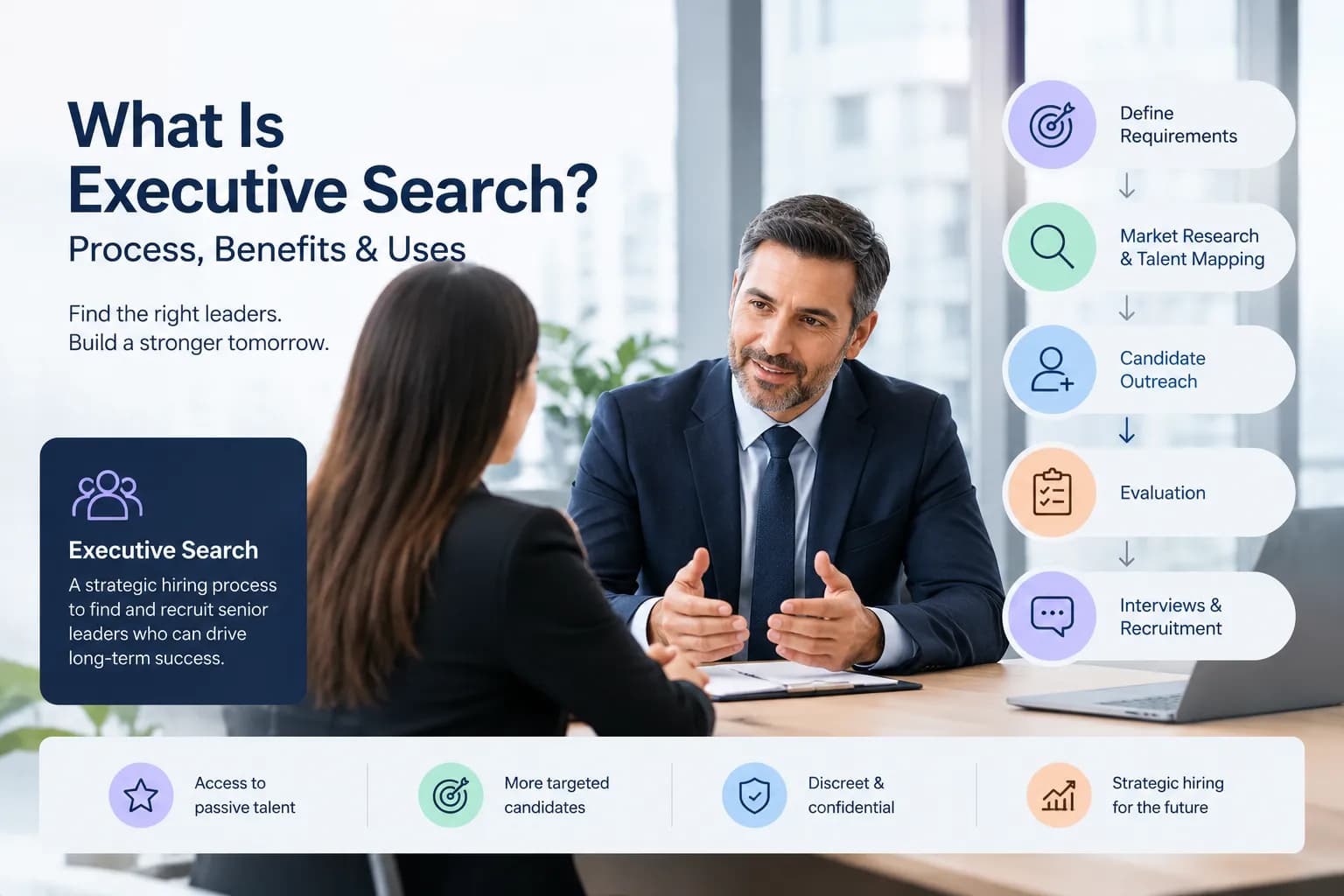
An executive search process can help businesses make informed hiring decisions. The process can include;
1. Identifying Leader’s Requirements
It should start with understanding the requirements of the organization in the first place, what it will require from a leader. It involves identifying the skills, qualifications, experience, and knowledge needed. This may be done through consultation with the appropriate parties.
For instance, if the firm is looking to grow its presence in the international market, it will need a sales executive who has experience in growing into new markets, managing regional teams, and forming strategic partnerships.
A detailed role description should include;
- Main duties and what is expected from the role
- Experience required within the industry/role
- Leadership and communication skills
- Who they will report to and the structure of the company
- Salary expectations and timeframes
Once this is done, the recruiters will try to look for the right companies, industries, and individuals.
Knowing who is out there in the market will help them know what they do and whether they will suit the job description.
This will be very necessary, especially in niche jobs.
3. Candidate Identification & Outreach
Recruiters will create a shortlist of candidates and professionally reach out to them.
As this is an executive headhunting process you will want to be discreet. You’ll usually ask candidates about their experience, leadership duties, interests and whether they would be interested in a new role.
You will want to be discreet and have clear communication.
4. Candidate Evaluation
The candidates shall be evaluated on the basis of the criteria stated. This would involve the use of structured interviews, evaluation of their employment history, their leadership qualities, and other relevant methods.
The candidates will be assessed based on their technical and leadership skills.
For example, a CFO will have good technical knowledge but also needs to have good decision making skills, risk management and be able to communicate financial strategy to other executives.
5. Interviews and Recruitment
The search team will arrange interviews between the selected candidates and the decision-makers. Feedback can be gathered, and expectations and assistance in salary negotiations and availability can be provided.
After choosing the preferred candidate, the hiring process is completed by the employer.
A good process in place would help you to communicate with the candidates who did not succeed.
What Are The Benefits Of Executive Search?
There are many benefits of using executive search to find experienced leaders for key roles;
- Passive Candidates – The recruiters may contact the appropriate professionals.
- Targeted Candidates – Talent Mapping is sure to assist you to identify appropriate candidates with appropriate experience.
- More Discreet – You can discreetly manage sensitive leadership roles and succession planning.
- Clear Criteria – Employers will have clear criteria to compare candidates.
- Strategic Hiring – You can focus on finding leaders with the right skills to support your future goals.
However, it will not guarantee a successful hire. This will depend on the quality of your search strategy, clarity of your brief, availability of candidates and decision making from the employer.
Executive Search Or Traditional Recruitment?
Whilst both processes aim to fill roles, there are some differences;
| Factor | Executive Search | Traditional Recruitment |
|---|---|---|
| Typical roles | Senior roles/strategic roles | Various roles at all levels |
| Candidate sourcing | Proactive search | Applications, databases, referrals and sourcing |
| Availability Of Candidates | Often includes passive candidates | Often includes active candidates |
| Discretion | Often important | Depending on the role. |
| Assessment | Usually tailored to leadership skills. | Based on criteria for the role. |
| Complexity Of Search | Often complex (for niche roles). | Varies depending on role. |
Neither approach is superior to the other. Traditional recruiting may work for all jobs that fall under operation and middle management levels. But if experience, confidentiality, and availability of candidates are an issue, then executive search may come into play.
What is Retained Search & When Should Companies Use It?
Retained search is a recruiting process which is used for This involves the company agreeing to pay a search firm a fee. Usually this will include a retainer and staged payments.
The search firm will usually be asked to perform a targeted search for a specific leadership role. The exact details will depend on the agreement.
Retained search may be useful if;
- The role is niche/business critical.
- The firm wishes to quietly insert an individual into a position of leadership.
- Finding candidates is difficult.
- The senior executives require a well-structured process.
- The organization must locate individuals who are not currently searching for jobs.
Before engaging any service provider, you should be aware of the kind of job they will do, the kind of services they will offer, how much it will cost you, what will happen in case they fail to find someone, how often they will update you, and how much time it will take.
When Should A Business Use Executive Search?
An executive search may also be a good option in case the position that needs to be filled has some strategic importance to the business other than just filling the gap. For example, if an IT company is expanding, they might need a CTO who can help them develop their products, form their engineering team, and grow their business. Even though advertising for this job will yield candidates, doing an executive headhunt for the right person who has that relevant experience would be a good choice.
If you decide on taking this route, you must consider three major points;
- Is the role complex and requires niche expertise/leadership experience?
- Are suitable professionals hard to find?
- Will this have an impact on the business?
If the answer to any of these is yes then an executive search could be a practical option.
What Value Does Elite Maverick Bring to Leadership Recruitment?
The choice of the recruitment partner will be crucial to your success. You would like to find someone who understands the job requirements, knows how to communicate, keeps things discreet and has a structured candidate assessment procedure.
Businesses looking for the right recruitment partner can explore Elite Maverick to learn more about its talent acquisition and workforce solutions.
Prior to beginning an executive search process, employers need to make sure that they have all of the following: a job description, selection criteria, realistic timeline, and decision-maker. We welcome any inquiry from your end if you would like to discuss your recruiting needs.
Conclusion
The executive search process would help you recruit the right senior professionals who will help you achieve your long-term objectives. Talent mapping, approaching the prospective candidates, evaluation and communication are the critical factors of the recruitment process.
For more recruitment insights, company updates, and talent acquisition tips, follow Elite Maverick on LinkedIn. You can also connect with us on Instagram for more updates.
Frequently Asked Questions
What Is Executive Search?
A structured process to identify the leadership requirements, identify candidates, assess, organise interviews and assist with hiring.
What Is The Difference Between Executive Search And Executive Headhunting?
Executive search is a general term for the whole recruitment process whilst executive headhunting usually refers to reaching out to potential candidates.
What Roles Require Executive Search?
Common roles include; CEO, CFO, CTO, COO, Vice President and other senior roles/strategic roles.
What Is Retained Search?
A process where the company agrees to pay a search firm a fee for carrying out a certain recruitment activity.
Is Executive Search Suitable For Small Businesses?
Yes. Small businesses could benefit from using this if they need a niche leader. However, it should be proportionate to your needs.